What a video interview feels like from the applicant's side, and why designing that journey well helps universities see the best in every candidate.
When a university invites an applicant to interview, it is asking them to perform at one of the most nerve-wracking moments of their academic life. How that experience feels, calm and fair, or confusing and stressful, shapes not only how well the candidate performs, but how they feel about your institution long before they ever set foot on campus.
This guide looks at the interview from the one perspective that is easiest to overlook when you are busy designing a process: the candidate's. Understanding their journey, stage by stage, helps admissions and academic teams design an experience that is fair to every applicant, reduces avoidable drop-off, and lets the strongest candidates show what they can genuinely do.
It is written for any university weighing up, or already running, online and video-based interviews.
Why the Candidate Experience Matters
It is tempting to treat an interview platform as a purely operational choice, a way to process more applicants with less staff time. That efficiency is real and it matters.
But the candidate experience is not a soft extra sitting alongside it; it directly affects the quality and fairness of your assessment.
An anxious, disoriented applicant wrestling with unfamiliar technology does not show you their ability, they show you their stress.
A candidate who feels the process is fair, clear and human gives you a truer picture of their potential.
And every applicant, successful or not, walks away with an impression of your university. The interview is often the most personal, high-stakes interaction they will have with you during the whole cycle. It is worth getting right.
Why It Matters to You
A better candidate experience is not just kinder, it produces better, fairer assessment data and protects your institution's reputation with every applicant you interview.
The Candidate's Journey, Stage by Stage
A good way to design a fair interview is to walk through it as the applicant experiences it, from the moment the invitation lands to the wait for a decision. Each stage carries its own anxieties, and each is an opportunity to reassure.
1. The Invitation
The experience begins the moment the applicant is invited.
A clear, welcoming invitation, one that explains what the interview involves, how long it will take, what is expected, and where to get help, sets the tone.
Ambiguity here breeds anxiety: an applicant who does not understand the format will worry about it for days.
For international applicants especially, clarity about timing, language and what "video interview" actually means removes a real source of stress.
2. Preparation and the Practice Run
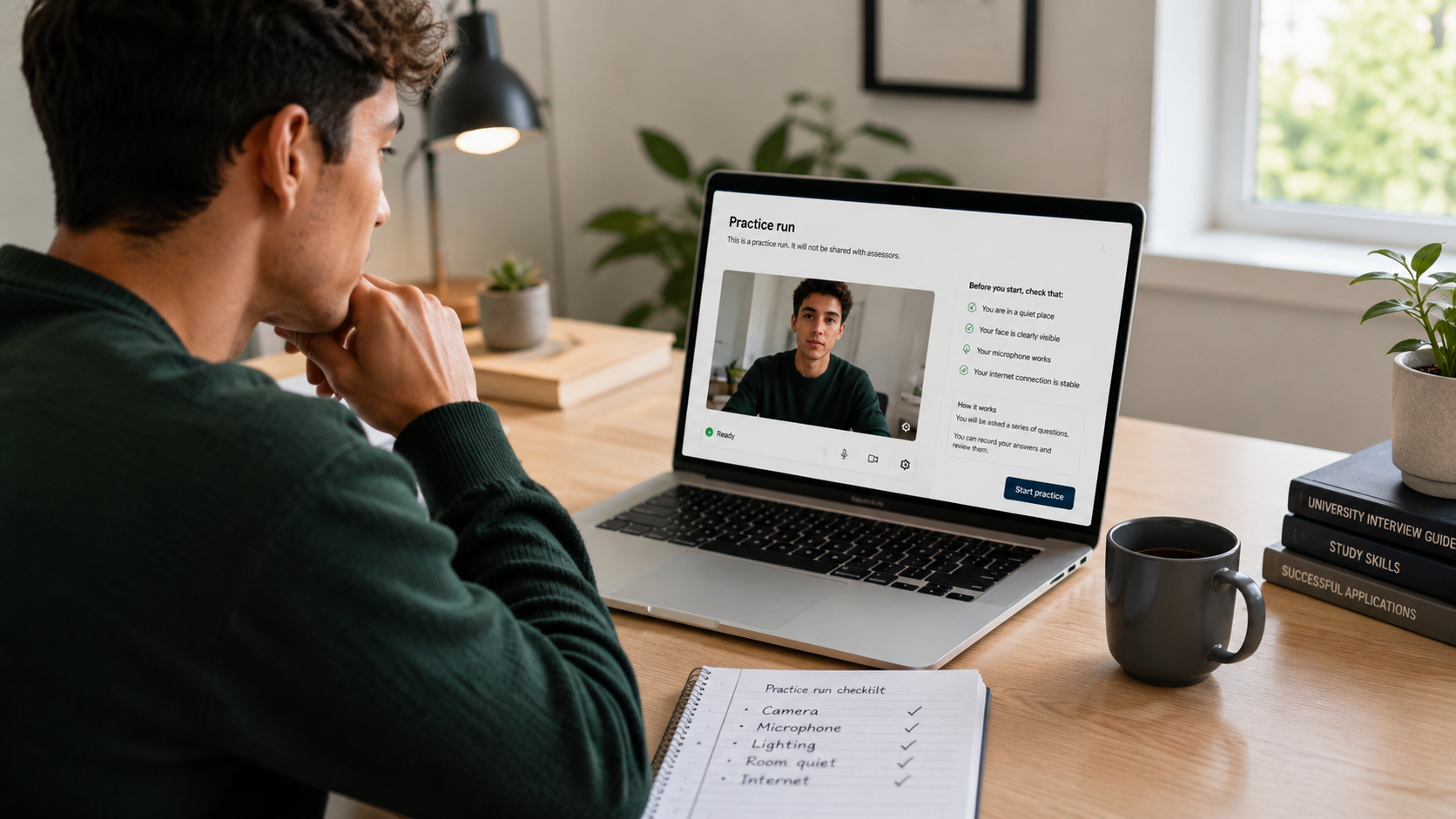
This is the stage universities most often underestimate, and where the candidate experience is most easily won or lost.
Most applicants have never taken a formal video interview. They do not know how they will look, how the timing works, or what happens if their internet drops.
That uncertainty is not a reflection of their ability, but it can badly affect their performance.
A genuine practice run, an identical, repeatable rehearsal that does not count towards their assessment, transforms this.
It lets the applicant check their camera and microphone, get used to the format, and arrive at the real interview knowing exactly what to expect.
Crucially, it levels the field: a confident, well-resourced applicant and a nervous first-generation applicant both start the real interview on equal footing.
Fairness begins here.
3. The Interview Itself
On the day, the experience should feel calm, professional and unmistakably yours.
A branded environment reassures the applicant they are in the right place and reflects your institution's care.
Clear on-screen guidance, a visible sense of how much time remains, and a straightforward path through each question let the candidate focus on their answers rather than the mechanics.
Whether the interview is asynchronous, where the applicant records answers to set questions in their own window, or live with an academic, the same principles hold: remove friction, be clear about what is being asked, and let the applicant concentrate on showing what they know.
An accessible experience that works on the device they actually have, including a phone, matters enormously for applicants who do not own the latest laptop.
4. After the Interview
The experience does not end when the recording stops.
An applicant who knows what happens next, when they will hear, how their interview will be assessed, is a calmer, more positively-disposed applicant.
Reassurance that a human is central to the decision matters too: candidates are increasingly aware of automated assessment, and knowing that real people are reviewing their responses builds trust in the fairness of the outcome.
Fairness Runs Through Every Stage
The thread connecting the whole journey is fairness.
Applicants arrive with wildly different resources, confidence, technology, quiet space, familiarity with interviews, prior coaching.
A well-designed experience narrows those gaps rather than widening them.
Fairness is not only an ethical obligation; it is what makes your assessment valid. If the experience advantages the confident and well-resourced, you are measuring circumstance, not ability.
What This Means for Your Process
Understanding the candidate journey leads to a few practical principles any university can apply, whatever platform sits behind the process.
Do this, and the interview stops being a hurdle that filters out the nervous and starts being a fair window into what each applicant can genuinely offer.
Practical Principles
- Communicate early and clearly, treat the invitation as part of the experience, not just an instruction.
- Offer a genuine practice opportunity, and make sure every applicant knows it exists.
- Present a branded, calm, accessible environment that works on everyday devices.
- Be transparent about timing, assessment and the role of human judgement.
- Design for your most anxious, least-resourced applicant, not your most confident one.
How WorkCast Approaches It
WorkCast's interview and assessment platform is built around exactly this experience: a calm, branded environment, a practice run for every applicant, clear timing and guidance, accessibility across devices, and human markers who make the assessment decision with the platform supporting them, never the other way round.
The aim is simple, to help universities see the best in every candidate, and to make sure the strongest applicants get the opportunity they deserve, wherever they are and whatever they bring with them.
Explore WorkCast for Universities
Discover how WorkCast helps universities create engaging, accessible online experiences that support prospective students throughout their journey.
Explore WorkCast for Universities → https://info.workcast.com/industry-universities
.png?width=2380&height=2380&name=%E2%80%9CClick%20here%E2%80%9D%20to%20view%20our%20open%20uni%20handbook%20(1).png)
Share this
-Jan-22-2026-03-04-15-6999-PM.png?width=1200&height=250&name=Untitled%20design%20(2)-Jan-22-2026-03-04-15-6999-PM.png)
Leveraging Authentic Student Interaction to Support Enrolment
-Jan-22-2026-04-13-31-1618-PM.png?width=1200&height=250&name=Untitled%20design%20(3)-Jan-22-2026-04-13-31-1618-PM.png)
Elevate Your Programmes with Dynamic Virtual Event Recaps