

There's something interesting about the way we consume podcasts.
We'll happily listen to two people having a conversation for 45 minutes while we're driving, walking the dog or making dinner. Sometimes the subject is something we know very little about, but we keep listening because the conversation itself is interesting.
Now imagine being invited to a 45-minute corporate webinar.
Does that sound quite as appealing?
Of course, podcasts and webinars serve different purposes. And we're certainly not suggesting that a Financial Services webcast discussing important market information should suddenly become an informal chat show.
But there's something worth exploring here.
What is it about podcasts that makes people want to keep listening, and could webinars learn a thing or two from that?
A conversation feels different from a presentation
Think about the podcasts you enjoy.
Chances are, the hosts aren't reading from a script for the entire episode. They're asking questions, reacting to answers, occasionally going off on a tangent and bringing the conversation back when they need to.
It feels natural.
Now compare that with a webinar where someone reads through 40 slides while the audience watches quietly.
Both formats can deliver useful information, but the experience is very different.
In Financial Services, presentations are often necessary. Investor updates, regulatory briefings and financial results can involve information that needs to be communicated accurately and consistently.
Nobody wants a presenter improvising their way through important figures.
But not every event has those same requirements.
A market outlook discussion, for example, could bring together two specialists with different perspectives. A client education session might work better as an interview between an expert and a host who asks the questions clients are likely to have.
The information is still there. It's simply being delivered in a way that feels more like a conversation.
Good podcast hosts are genuinely curious
One of the things that makes a podcast enjoyable is a host who actually listens to the person they're speaking to.
Not someone who asks a question, waits for the answer and immediately moves on to the next one on their list.
Someone who's interested enough to ask, "Can you explain what you mean by that?" or "That's interesting, why do you think that happens?"
Those little follow-up questions can take a conversation somewhere unexpected.
And they're particularly useful when the guest is an expert.
People who work with a subject every day sometimes forget which parts might need explaining to someone outside their field.
A good host can bridge that gap.
For Financial Services webinars, that might mean having a moderator who understands the subject but isn't afraid to ask for clarification.
They don't need to pretend they know less than they do. They just need to think about what the audience would find useful.
It's a small difference in approach, but it can make the conversation much more interesting to follow.
Not everything needs a slide
We love a good presentation. We work with them every day.
But sometimes we wonder whether we've become a little too dependent on PowerPoint when it comes to webinars.
Podcasts don't have slides to fall back on.
The conversation has to do the work.
That means speakers need to explain their ideas clearly, use examples and give listeners enough context to follow what they're saying.
Webinars have an advantage here because they can combine that conversation with visuals when they're genuinely useful.
A chart illustrating market performance? Absolutely.
A diagram helping explain a financial process? Great.
A slide containing six paragraphs that the presenter is about to read word for word? Perhaps not quite so necessary.
There's no reason a webinar can't move between a conversation and supporting visuals.
In fact, that variety can make the experience feel more natural.
Personality doesn't have to mean losing professionalism
Financial Services is an industry where credibility matters.
Audiences expect knowledgeable speakers, accurate information and a professional experience. Quite rightly.
But professionalism and personality aren't opposites.
A presenter can be knowledgeable without sounding rehearsed. A discussion can be informative without being overly formal. And speakers can have a genuine conversation while still treating the subject with the seriousness it deserves.
Sometimes the most memorable part of a webinar isn't a perfectly designed slide.
It's the moment someone shares an interesting perspective, explains something particularly well or responds to a question in a way the audience wasn't expecting.
Those moments are difficult to manufacture.
But giving speakers a little room to be themselves can help them happen.
We've noticed this with Webinars Unfiltered
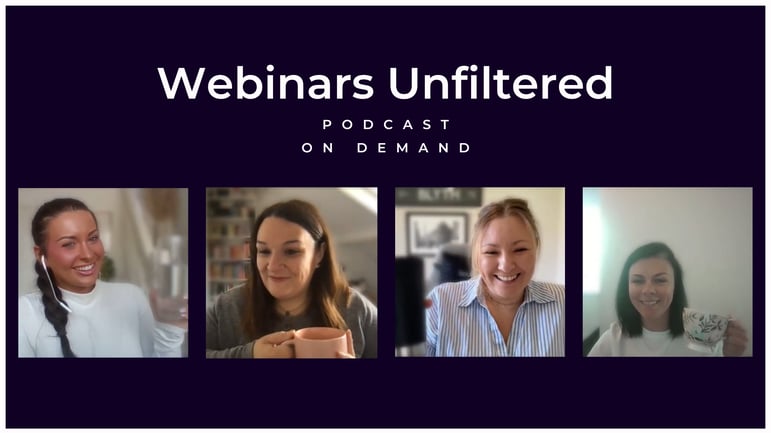
At WorkCast, we produce our own podcast, Webinars Unfiltered.
And one of the things we enjoy about recording it is that it gives us space to have conversations we wouldn't necessarily have in a traditional presentation.
We usually have a subject in mind and a few questions prepared, but we don't try to script every answer.
Sometimes someone makes a point that takes the conversation in a slightly different direction. Sometimes a follow-up question turns out to be more interesting than the one we'd originally planned.
That's part of what makes recording it enjoyable.
It also reminds us that the people delivering an event are just as important as the format they're using.
You can have an excellent topic, experienced speakers and a polished setup, but the way people communicate still makes a difference.
And that's relevant whether you're recording a podcast or delivering a Financial Services webcast.
But webinars have something podcasts don't
There's one important difference we haven't mentioned yet.
Webinars can give the audience a way to join the conversation.
With a podcast, listeners generally hear the discussion after it's been recorded. They can't usually stop the hosts halfway through and ask them to explain something.
With a live webinar, that opportunity exists.
Audience questions can introduce perspectives the speakers hadn't considered. A moderator can bring those questions into the discussion while the subject is still being explored.
For Financial Services events, questions may need to be reviewed or moderated before they're answered, particularly where the discussion involves sensitive or regulated subjects.
That doesn't take away from the value of audience participation.
It simply means the interaction needs to be managed appropriately.
And when it's done well, it can add something that even a really good podcast can't offer.
Perhaps we should stop thinking every webinar needs to look like a webinar
We're not suggesting Financial Services organisations abandon presentations, throw away their slides or turn every webcast into a podcast.
There are plenty of situations where a structured presentation is exactly the right format.
But there are also opportunities to try something different.
An interview with an industry expert. A conversation between two investment specialists. A moderated discussion about an emerging topic. A client education session built around the questions people actually want answered.
All of these can still be webinars.
They just don't have to follow the same format.
And perhaps that's the biggest thing webinars can learn from podcasts.
Sometimes people are just as interested in hearing a good conversation as they are in watching a good presentation.
Looking to try a different format for your next Financial Services event?
WorkCast supports everything from traditional presentations to interviews, panel discussions and other online event formats, with options for self-service and managed delivery.
