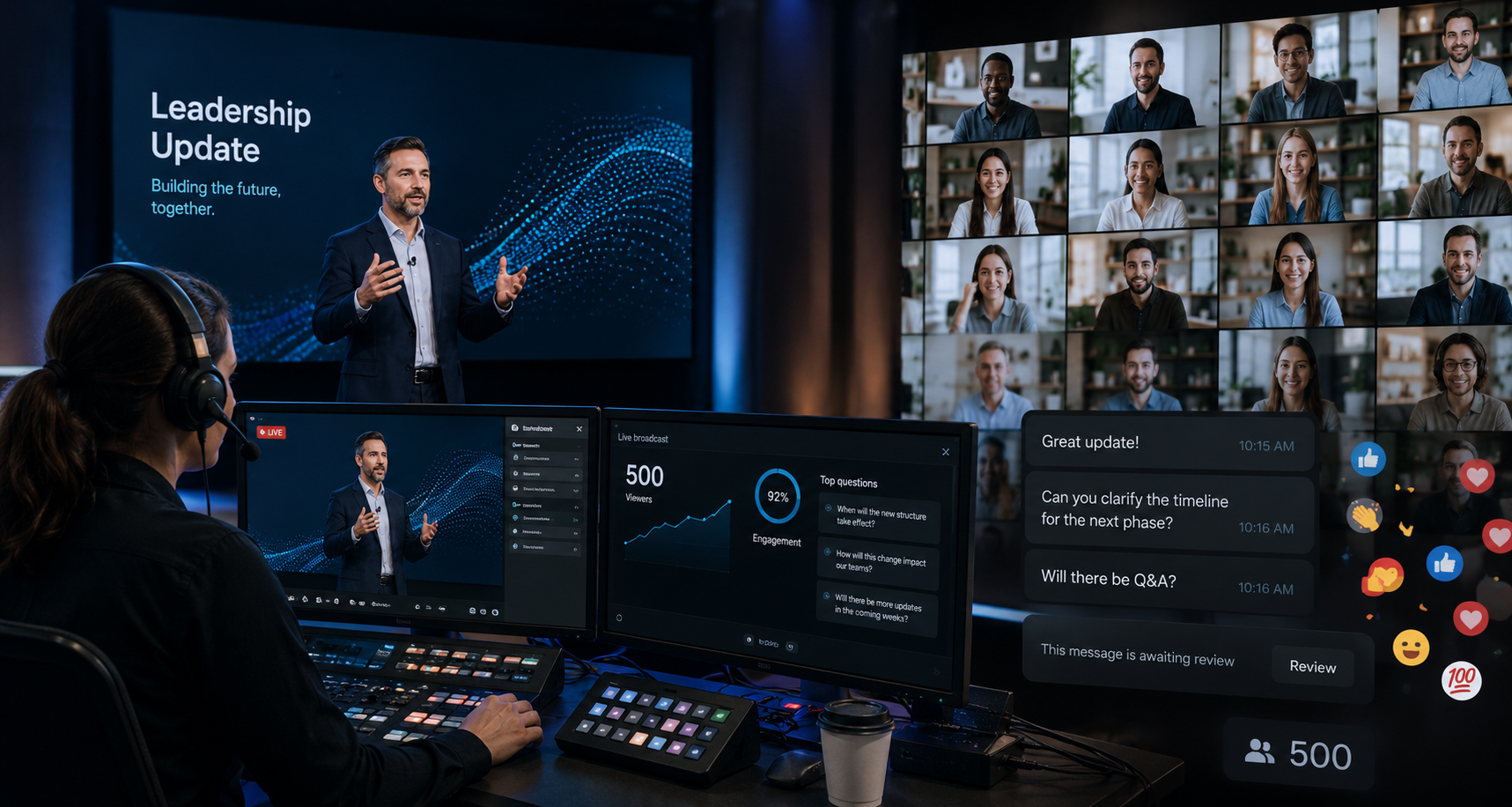
Most organisations approach internal communications the same way. A town hall gets scheduled when there is something to announce. A briefing goes out when leadership has time. An all-staff update happens when someone remembers to book it.
The result is a fragmented, reactive communications calendar that leaves employees feeling uninformed between events and overwhelmed when multiple things land at once.
A structured annual leadership broadcast programme fixes this. Here is how to build one.
Start With the Communications Cadence, Not the Content
The most common mistake internal communications teams make is planning content before planning frequency.
Before deciding what to say, decide how often different types of communication need to happen and in what format. A useful starting framework for a mid-to-large organisation looks like this:
- Two all-staff briefings per year for major strategic updates from C-Suite
- One to two panel Q&A sessions for open discussion on specific topics or changes
- Two recorded broadcasts for compliance or policy communications that need to reach shift workers and remote employees
- Four to six on-demand updates for shorter, regular communications that employees can watch in their own time
- One multi-session event for a larger company-wide or departmental gathering
This gives you a programme of ten to twelve events across the year before a single piece of content has been written. That structure is what keeps communications consistent rather than reactive.
Match the Format to the Message
Not every internal communication needs to be a live event. Choosing the wrong format is one of the most common reasons leadership broadcasts underperform.
Live all-staff briefings work best for announcements that benefit from real-time Q&A, where leadership wants to take questions and demonstrate openness. Simulive broadcasts work better for compliance communications, policy updates or messages that need to reach employees across multiple time zones, because content can be checked before it goes out and broadcast at multiple scheduled times from a single recording. On-demand updates work best for shorter, regular communications where employees need flexibility to watch when they have time.
Getting this match right reduces the pressure on leadership time, improves reach and makes the content more likely to land with the intended audience.
Build the Calendar Around Known Organisational Moments
Annual communications programmes work best when they are anchored to moments the organisation already plans around. End of year updates, quarterly financial results, new policy rollouts, strategic planning cycles and compliance deadlines are all known in advance.
Map these moments at the start of the year and assign a format and a rough date to each. This gives internal communications teams enough lead time to plan content, brief leadership and manage production without everything becoming last-minute.
It also prevents the common problem of two major communications landing in the same week because no one had visibility of the full calendar.
Plan for On-Demand From the Start
Every live or simulive broadcast should be planned with on-demand access in mind from day one, not as an afterthought.
Employees on shift patterns, in different time zones or returning from leave need to be able to access the same content as those who attended live. Building on-demand access into the plan from the start means the recording is structured, hosted and reported on properly rather than shared as an untracked video file after the event.
A webinar library that houses all past broadcasts gives employees a searchable, always-available record of leadership communications across the year.
Measuring What Works
An annual programme is only as good as the data it generates. After each event, internal communications teams should be looking at attendance rates by department and location, engagement during the session including poll responses and Q&A activity, drop-off points that indicate where content lost the audience, and on-demand viewing numbers in the weeks after the live date.
Over time this data shows which formats work best for which audiences, which topics generate the most questions and where the gaps in the communications calendar are.
How WorkCast Supports Annual Internal Communications Planning
WorkCast is built to support structured annual communications programmes across all five event formats. Live, simulive and on-demand events sit within a single platform with consistent branding, reporting and audience management. A branded webinar library houses all content in one place. And reporting across the full programme gives internal communications teams and leadership the data they need to demonstrate impact and refine the plan year on year.
Organisations including Ofsted and Version 1 use WorkCast to run annual internal communications programmes that reach every employee regardless of location, shift pattern or time zone.
See how WorkCast structures an internal communications programme for your organisation: https://info.workcast.com/solutions-internal-communications


.png?width=2380&height=2380&name=%E2%80%9CClick%20here%E2%80%9D%20to%20view%20our%20open%20uni%20handbook%20(1).png)