Internal Communications · 10 Mar 2026 · 4 min read
Low attendance. Passive viewing. No data. Leadership frustrated that messages aren't landing. If this sounds familiar, the problem probably isn't your message — it's your format.
The Format Is the Problem
Most organisations running all-staff briefings are using tools built for something else entirely.
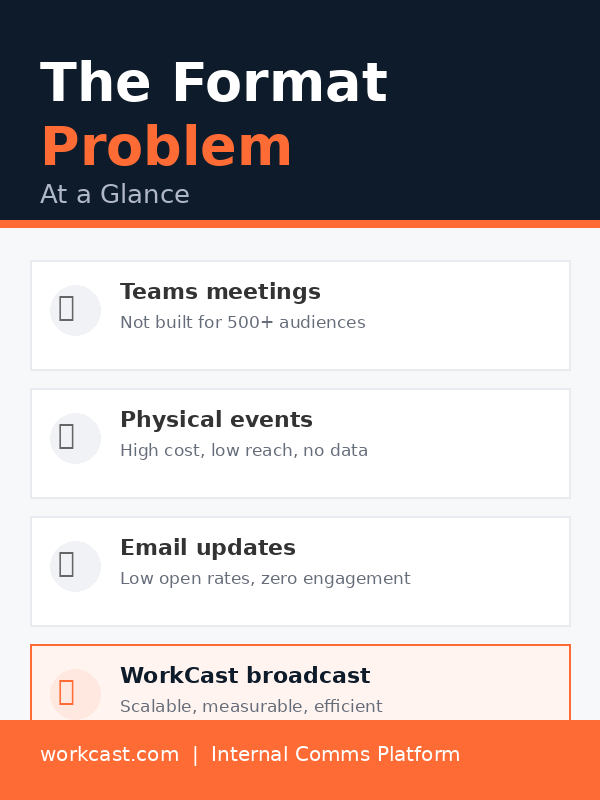
Microsoft Teams was designed for collaboration between small groups. Physical town halls were designed for a pre-remote, pre-global workforce. Neither was built to communicate a strategic message to hundreds or thousands of employees across different time zones, shifts and locations.
When the format doesn't match the need, the results show up as exactly the symptoms described above: disengaged audiences, poor attendance, and leadership who can't tell whether anything landed at all.
What a Structured Broadcast Approach Looks Like
Organisations that get internal communications right tend to stop thinking about individual events and start thinking about a programme.
That means matching the format to the message — not defaulting to the same tool for everything. A typical well-structured internal communications calendar might include:
- All-staff briefings — live or simulive, 1–2 hours, for company-wide strategic updates from the C-suite
- Panel discussions with moderated Q&A — for introducing change, new leadership, or topics that benefit from open dialogue
- Pre-recorded broadcasts with live Q&A — protecting executive time while still enabling real interaction
- Short on-demand updates — 3 to 30 minutes, for regular communications that employees can view at a time that suits them
- Multi-session events — for larger strategy days or organisation-wide gatherings
Each format has a specific purpose. Using the right one makes the difference between a communication that lands and one that doesn't.
Why Leadership Time Is the Hidden Cost
One of the most underappreciated problems in internal communications is what it costs to get senior leaders in front of a large audience repeatedly.
Simulive formats — where content is pre-recorded and broadcast as live — solve this directly. Executives record once. The content is reviewed and approved before it goes out. It then reaches every employee, regardless of shift pattern or time zone, without requiring anyone to be live on the day.
For organisations with global teams or shift-based workforces, this isn't just more convenient. It's the only format that actually works at scale.
The Engagement Data Problem
Most organisations running all-staff communications through Teams or physical events have no idea what happened afterwards.
Did people attend? Did they stay? Did the message connect? What do employees actually think?
A structured broadcast platform changes this entirely. Attendance data, poll responses, Q&A participation and on-demand viewing figures all become available as standard — giving internal communications teams the evidence they need to improve over time and demonstrate impact to leadership.
Advanced polling also enables real-time eNPS capture inside the event itself. Rather than sending a survey link that gets ignored, employee sentiment is gathered in the moment — when the audience is already engaged, and the response rate is dramatically higher.
What Good Looks Like
Organisations doing this well — including regulated businesses in financial services and large public sector bodies — tend to share a few characteristics:
- They run a planned annual communications programme, not ad hoc events
- They use different formats for different message types
- They protect leadership time through simulive and pre-recorded options
- They measure every communication and use the data to improve
- They treat the platform as a governance and compliance tool, not just a delivery mechanism
The result is higher engagement, lower cost, and far less organisational disruption — with communications that employees actually remember.