Inconsistent branding during virtual open days does more damage than most teams realise.
Different slide styles.
Off-brand colours.
Unstructured layouts.
Disconnected experiences across sessions.
When branding feels patchwork, confidence drops.
For universities, virtual open days are high-stakes recruitment moments. Brand consistency builds trust, reinforces identity, and supports confident decision-making.
Here’s how to lock it in properly.
Why Brand Consistency Matters in Student Recruitment
Prospective students are not just evaluating courses. They are evaluating credibility.
A cohesive, professional virtual environment signals:
- Organisational confidence
- Attention to detail
- A strong institutional identity
If sessions feel inconsistent or improvised, it subtly affects perception.
Consistency is not about logos alone. It is about creating a recognisable, structured experience from registration to follow-up.
Using Customisable Templates to Protect Your Brand
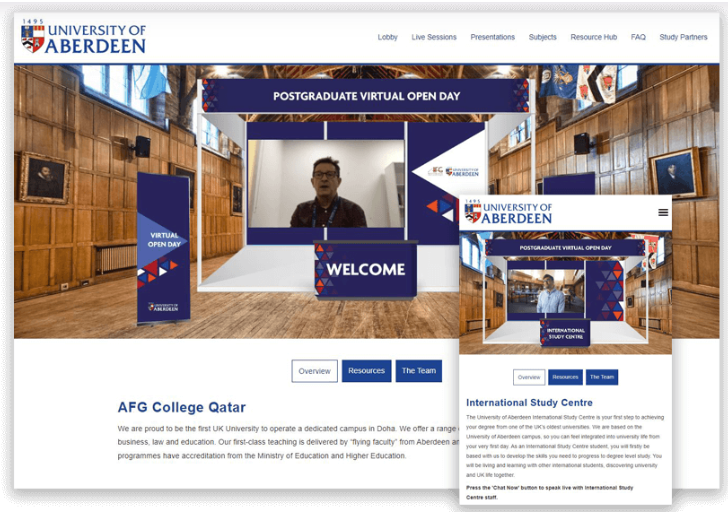
Customisable webinar templates remove the risk of inconsistency.
Instead of rebuilding every virtual open day from scratch, templates allow marketing and recruitment teams to:
- Lock in approved colours and typography
- Standardise layout and navigation
- Ensure faculty sessions align visually with institutional branding
- Maintain accessibility standards across events
For universities running multiple open days across faculties and departments, this structure is essential.
Templates reduce manual effort while protecting brand integrity.
Branding Beyond Visuals
Brand consistency also extends to experience.
A well-designed virtual open day should feel cohesive across:
- Registration pages
- Waiting rooms
- Live sessions
- Breakout rooms
- On-demand recordings
When each touchpoint reflects the same identity, the experience feels intentional rather than assembled.
Consistency supports clarity. And clarity supports conversion.
Improving Efficiency Without Sacrificing Quality

Virtual open days require coordination across marketing, admissions, academics, and IT teams. Speed matters. But so does polish.
Reusable Content Blocks
Reusable content blocks allow teams to save:
- Intro slides
- Poll formats
- Registration forms
- Q&A structures
- Accessibility notices
This approach ensures quality remains high even when event frequency increases.
For universities hosting multiple recruitment events throughout the year, this reduces preparation time while maintaining consistency.
Built-In Engagement Tools
Engagement tools such as live polling and moderated Q&A should feel like part of the experience, not add-ons.
When embedded within branded templates, they support interaction without disrupting visual flow.
Interactive elements should complement brand identity, not compete with it.
Connecting Branding to Measurable Impact
Brand consistency is not just aesthetic. It supports performance.
When virtual open days feel structured and professional:
- Students stay engaged longer
- Sessions feel easier to navigate
- Confidence in the institution increases
- Follow-up communication feels cohesive
Consistency also supports data tracking. When templates standardise session formats, analytics become easier to compare across events.
CRM Integration and Follow-Up Alignment
Brand integrity should continue after the event ends.
When your virtual open day platform integrates with your CRM, follow-up communication can:
- Reflect the same visual identity
- Reference sessions attended
- Align with faculty-specific branding
- Maintain tone and messaging consistency
This continuity reinforces trust and keeps momentum moving.
From Consistency to Conversion
Virtual open days are recruitment touchpoints, not standalone broadcasts.
When branding is locked in through structured templates, reusable components, and integrated systems, universities gain:
- Stronger institutional presence
- More efficient event production
- Clearer analytics
- More consistent follow-up
Most importantly, students experience a confident, professional environment that reflects the standards of the institution itself.
If you are reviewing how your virtual open days represent your brand and support recruitment outcomes, explore how WorkCast helps universities deliver consistent, scalable virtual event experiences designed for student conversion.
Share this

Creating Connections: Building a Sense of Belonging Through Virtual University Events

Harnessing Social Proof in Higher Education Recruitment